
Perseverance Flow
Natural Information Society
 bandcamp digital album
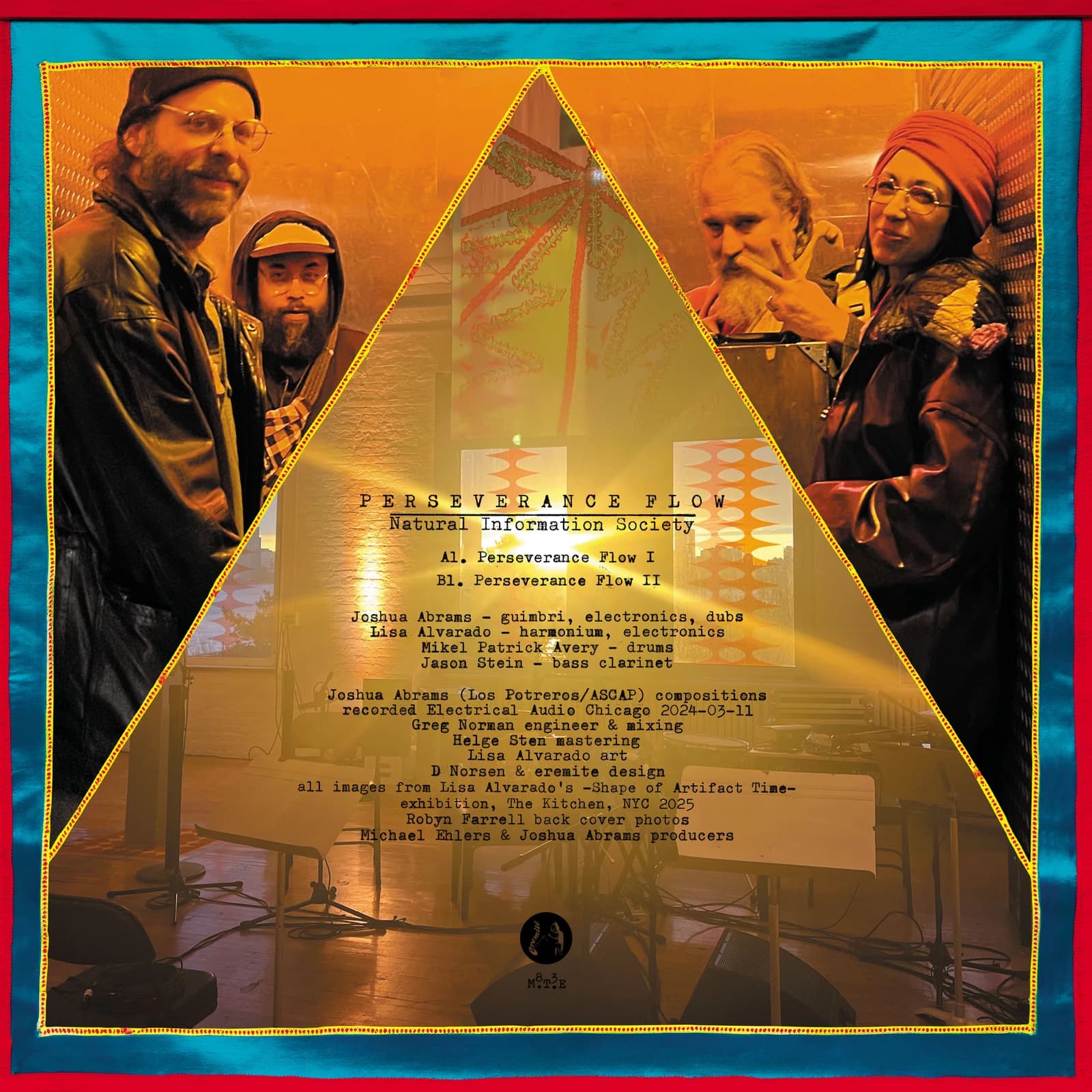
Personnel
Joshua Abrams guimbri, electronics, dubs
Lisa Alvarado harmonium, electronics
Mikel Patrick Avery drums
Jason Stein bass clarinet
Track Listing
MTE-83 Side 'A'
1. Perseverance Flow I
MTE-83 Side 'B'
2. Perseverance Flow II
Audio Clips
Perseverance-Flow, Jump Rope edit
4.99 MB
Recording Notes
recorded Electrical Audio, Chicago 2024-03-11
engineer Greg Norman
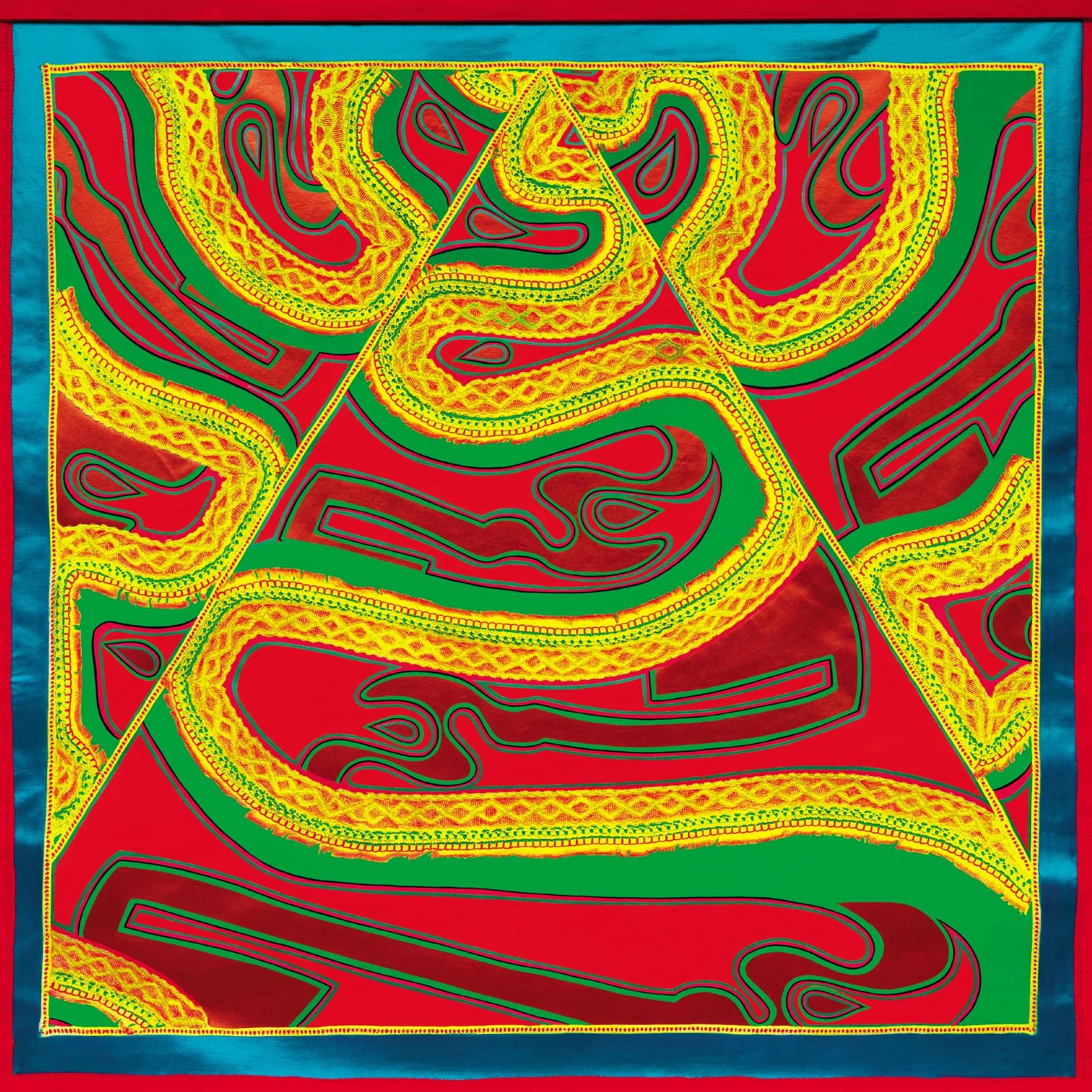
all artwork from Lisa Alvarado’s Shape of Artifact Time exhibition, The Kitchen, NYC 2025
producers Michael Ehlers & Joshua Abrams
Description
Announcing Perseverance Flow, the latest album from acclaimed Chicago-based ensemble Natural Information Society (NIS). After a trilogy of double LPs by expanded manifestations of the band that began in 2018 with Mandatory Reality & continued through Since Time Is Gravity (a Pitchfork Best Jazz & Experimental Album of the Year selection & Mojo’s #1 Underground Album of 2023), NIS returns to its core formation of Lisa Alvarado on harmonium, Mikel Patrick Avery on drums, Jason Stein on bass clarinet, & composer/multi-instrumentalist Joshua Abrams on guimbri for one continuous 35 minute composition across a single LP. As the rocket boosters on spaceship earth sputter closer to burnout, lower your stylus into a soundfield that grows stronger the deeper you travel into it; a dose of the medicine many of us look to music to deliver awaits you inside.
One of the deep contemplations of this natural information (thanks Bill Callahan) is the wide range of source materials Abrams draws from over the band’s more than 15 year history: Ideas from minimalism, modal jazz & traditional musics are regularly reimagined in these compositions. The 2021 double LP descension (Out of Our Constrictions), with guest soloist Evan Parker, reflected aspects of Abrams’ love of party music, Chicago house, & John Coltrane. *But even veteran travelers with the NIS best brace themselves for the Perseverance Flow.
Speaking to the history & the inspirations behind the album, Abrams offers: “We played the piece for a year in concert before the recording. At Electrical (Audio Studios, Chicago) we went in at 11 & were done in time to pick our kids up from school.” Abrams continues: "In a reference world, I imagine Perseverance Flow like a live extended realization of a Jaylib lost instrumental as remixed by Kevin Shields. Or vice versa. I also think it has sympathies to some of the more rhythmically intricate dance musics out of Chicago & Lisbon.”
The core NIS ensemble heard on Perseverance Flow always address Abrams’ writing with the discipline of orchestra musicians & the creativity of improvisers. But this time around, instead of inviting living legend status musicians Evan or William Parker or Ari Brown as honored guests to solo freely over the composed materials, Abrams’ invited guest collaborator was the medium of the recording studio itself. Situated at the board with engineer Greg Norman, Abrams pushed post production techniques found only sporadically on earlier NIS records deep into the heart of the music, distorting & reshaping instruments to subtly &, at times, aggressively mutate timbre & texture, color & time.
Refracting the band’s signature mesmerizing chains of overlapping rhythmic patterns through the sonic funhouse of dub makes Perseverance Flow the most formally experimental NIS album to date. Now a soundworld fully unique to itself is listening to itself, consoling & humoring itself, & consoling & humoring you. A destruction myth & a creation myth of a soundworld together at once —"energetically nutritious” (October 2025 Issue 500 The Wire) supernatural information society.
“Perseverance Flow is skipping rope in slo-mo. A dance of co-operation to rally guts & humors & keep marching through pouring tears” (Abrams).
Release date 2025-10-24. 1st eremite edition pressed on premium audiophile-quality 140 gram vinyl at Fidelity Record Pressing from Kevin Gray/Cohearent Audio lacquers. Mastered by Helge Sten (Deathprod). 1st 300 direct order copies include eremite’s signature retro-audiophile inner-sleeves hand screen-printed by Siwa Studios, Northern New Mexico. CD & EU vinyl edition available from our partner Aguirre Records. Digital files available at eremite records bandcamp. Available on streaming platforms via New Soil Music.
Among the defining projects in 21st century underground music, Natural Information Society has previously released 7 albums on eremite to great critical acclaim, & on Drag City records 2 collaborative albums with Bitchin’ Bajas. Since returning to bandstands in the aftermath of the COVID-19 pandemic, Natural Information Society has performed at Big Ears, Pitchfork Music, Guelph Jazz, & Jazztopad Festivals (2022), the Vision Festival, Jazz em Agosto, Le Guess Who, & Jazzfest Berlin (2023), FIMAV, Hyde Park Jazz, & Jardin Sonoro Festivals at Instituo Inhotim (2024). The band has performed in conjunction with exhibitions of Lisa Alvarado’s visual work at venues including REDCAT (Disney CalArts), Wadsworth Atheneum, Moody Center, & The Kitchen.
The Wire 2025 Rewind #23 album all genres
Aquarium Drunkard 2025 Year in Review
Magnet Best Jazz / Improv 2025
Recliner Notes Favorite albums of 2025
Press
An outstanding Chicago bassist, Joshua Abrams regularly contributes to a host of bands, drawing on roots from hip-hop to free jazz. He also leads a singular project, Natural Information Society (NIS), a band that stretches across time, origins, technologies and sources, and one which has mutated significantly in its 15-year history, documented on a series of Eremite LP releases. Abrams also plays guembri, the bass lute of the Gnawa people of North Africa, introduced to free jazz circles by Moroccan master Maleem Mahmoud Ghania, who in the ’90s stepped outside traditional circles to play with saxophonists Pharoah Sanders and Peter Brötzmann and percussionist Hamid Drake, the latter an occasional member of NIS. Recent NIS recordings include two double-LP sets, Since Time Is Gravity, by an 11-member Community Edition and descension (Out of Our Constrictions) by the current core quartet of Abrams, Lisa Alvarado (harmonium), Mikel Patrick Avery (drums) and Jason Stein (bass clarinet), with Evan Parker (soprano) joining them on a single 75-minute piece.
With Perseverance Flow, Abrams, as composer and producer, takes NIS in another direction, composing a piece for the quartet’s distinctive members and instruments, then editing and processing the results into a serene, pulsing, repeating work with regular shifts and time markers, transforming instrumental identities into novel sounds and short modular phrases. There’s a melody that’s regularly an extended and shifting ostinato, there’s another that’s a high-pitched soprano, more minimal still and not readily traceable to an originating sound, though the bass clarinet may be the likeliest contender. These alterations are such that only percussion and guembri are frequently identifiable. Stein’s bass clarinet only becomes strongly evident as itself nine minutes in. A certain repeating jump-start suggests a grand piano’s bass figure or the clicking of an MRI machine, yet this technological dream with its resonating soprano melody remains so fiercely human and fundamentally American that the album forms loose affiliations with music as far flung as Santo & Johnny’s “Sleep Walk” and Harry Partch’s Delusion of the Furies. The submerged instrumental identities contribute to the dream-like state, as if original sonic personalities have gone to sleep, and the results suggest a sustained techno-lullaby, a kind of mechanized bliss, a harbinger, perhaps, of the music currently most needed.
Stuart Broomer, New York City Jazz Record
The piece, called “Perseverance Flow,” began slowly, with Abrams playing rhythmically on a gimbri—a Sub-Saharan, three-stringed, skin-covered box—in his lap. Alvarado, on hand-pumped harmonium, let the reeds make chords that filled the room. Mikel Patrick Avery, on a drum kit, launched a bass drum’s beat through mists of percussion, and on bass clarinet, Jason Stein made sounds like swells and piercing winds. It was rhythms intersecting rhythms, and the room felt like an ocean, the seas shifting, tide coming in. But then, after an hour that felt like minutes, Alvarado’s chords led us home safe, the sounds calming, the room still vibrating, the chords resolved, the world a different place.
Robert Sullivan, Vogue
Joshua Abrams leads the Natural Information Society quartet into battle, or at least toward it, on the joyfully meandering instrumental album Perseverance Flow. Proceeding in a march of trancelike, intoxicating repetition, Abrams and his bandmates embark on a 35-minute pilgrimage to the place where jazz, contemporary classical, and multinational folk convene, achieving singularity in a state of ritual rhythm.
pitchfork
Spacemen 3 used to promote their music as being for the “fucked up children of the world,” in addition to the more famous part about taking drugs to make music, etc. Natural Information Society could be described in a similar fashion, except they make music for the fucked up adults of the world, the kind who still take drugs and are baffled by their peers bending over backwards to make “the kids” think they’re cool by slobbering over music clearly made for children. If you count yourselves among the former, the Chicago band’s latest is made for you: sophisticated psychedelia pulsing with rhythmic intensity and rich with droney waves of harmonium. Made up of a single slow-burning, 37-minute long jam, the movement here is subtle yet in its own way aggressive and sharply focused, carefully drawing the listener into the widening gyre at the center of the band’s humane, organic trance.
Mariana Timony, bandcamp daily essential releases
Anyone who’s studied meditation or watched a Formula 1 race knows you can travel great distances without going anywhere at all—and enjoy the process of not getting there. There’s pleasure in following a circuit so frequently and so closely that everyday bits of the landscape become landmarks (we always pass that bullet-holed stop sign on this route) and a pang when those landmarks change (they replaced the stop sign!). Natural Information Society’s music operates on similar principles, drawing together the thrum of Moroccan gnawa, the austere profundity of Philip Glass, and the circular structures of John Coltrane at his most spiritual into a sound that doesn’t progress so much as it rotates. Its pleasures come from the steady accumulation of repetitions and all the little tweaks and evolutions and devolutions that composer Joshua Abrams and his band have built into their music.
Perseverance Flow is Natural Information Society’s first non-collaborative record since 2023’s jazz-fractaled Since Time Is Gravity. That album presented a more relaxed version of the group, unfurling its music as though rolling out a dusty Turkish carpet. Perseverance Flow’s tight focus—one theme looped ceaselessly, with modest embellishment, for 35 minutes—feels like a microscopic view of that same rug. The phrase is initially tight and loping: a two-note harmonium riff, a lightly heraldic bass clarinet, Abrams’ clip-clopping guembri, a little one-two drumbeat, all of it held together as tightly as pencils bundled by a rubber band. The group performed the piece live for a year before recording, which gives the album a warm and lived-in feel despite its formal constriction; imagine the Sun Ra Arkestra in big-band mode, playing a single bar over and over until achieving liftoff. Taking equal inspiration from Jamaican dub and Chicago dance music, Abrams edited the one-take performance in post-production, dropping in tonal tweaks and rhythmic inversions with a jeweler’s eye for detail.
In the same way that a diamond’s symmetrical shine is both easy to admire and requires an eyepiece to appreciate in full, Perseverance Flow’s charm is shaped by the tiny variations built into the score. Once the theme is established and allowed to settle, harmonium player Lisa Alvarado flips her pattern, playing a palindrome of the simple rise-and-fall melody. The shift is so smooth it can take a moment to notice it’s happened, and even then you might second-guess the extent of the change. Drummer Mikel Patrick Avery loosens his percussion a few minutes later, playing something that sounds like pebbles sloshing in a plastic bucket. The soft shuffle is soon absorbed—whether actually or just by a kind of aural illusion—into the original pattern. Abrams anchors the sound with his Moroccan guembri, occasionally halting the steady limp of the primary line to tie a fluid knot without losing a step.
While it’s not unusual for repetition to turn a musical phrase inside out, similar to the way a word loses its meaning once you’ve said it a few times, Perseverance Flow’s emotional register stays constant. The phrases gradually begin to lengthen—at one point, Alvarado’s harmonium sounds more like an accordion playing a Cajun song in slow-mo—which gives the piece enough momentum to stay grounded. At no point does it even glance in the direction of chaos; you could probably thread a needle with the sound wave. Around the 19-minute mark, the entire ensemble pulls up together in a way that suggests a vamp, then immediately falls back into the pattern without anyone losing their place. It’s such a weird little thrill that, if you’re properly locked in, it feels like peaking in sync with a 2 a.m. bass drop.
While the instrumentation wouldn’t be out of place at your local roots festival, the dance music influence on Perseverance Flow is undeniable. Abrams’ frequent switches and intertwined notes mimic the braided bass hits and glitchy rhythms of footwork without ever leaving the aesthetic context of gnawa. Little clap-back rhythms pop up occasionally. At one point, something that sounds like a bag of shells being dropped on a snare drum introduces a new back-and-forth to the theme that matches the harmonium and brings the piece’s shuffle closer to something like hip-hop. It’s a canny way of making sure the listener’s body stays tuned in to what could easily become cerebral; you will not nod your head more insistently to a piece of experimental music this year.
Two-thirds of the way through, Avery pounds what sounds like a heavily padded kick drum in double time, just off-beat and distant enough to make it feel like the thump of a poorly insulated club. Abrams picks up the new rhythm and follows it, and for a few moments, the band seems to be playing both the main Perseverance Flow theme and a separate dance song at the same time, though the theoretical line between the two is impossible to find. Eventually, that intervention fades, too, revealing that each of the musicians is off doing their own thing, and despite that, feeling more like an ensemble than ever.
Music like this sometimes gets called “durational,” or likened to the theoretical impermanence of Zeno’s Arrow—an object that appears constant yet is recomposing itself in every moment. It is hard, listening to Perseverance Flow, not to think of the Buddhist notion of becoming, or something like philosopher Henri Bergson’s conception of the élan. Both of which are fair descriptions and logical reactions to a music that seems to do nothing but go in circles with academic confidence. But merry-go-rounds go in circles, too. As do pinwheels. You want durational? Major League Baseball teams play 162 games every season, usually for the same few thousand people. Despite the weight of the intellectual concepts and the elegance of the score, despite the band’s association with the cream of Chicago’s always-rich avant-garde scene, this record is no less approachable than an afternoon Cubs game. Appropriately enough, it gets better with each spin, too.
Sadie Sartini Garner, pitchfork
Paring down to a quartet and using the studio (and a year of rehearsals) as the palette, Joshua Abrams, his guimbri, and co. (Lisa Alvarado, harmonium; Jason Stein, bass clarinet; Mikel Patrick Avery, percussion; Electrical Audio, machine shop; Greg Norman, shop steward) take a memorized new composition and play the parts for a methodical, controlled clockdown. “Perseverance Flow” is a 35-minute elephant walk across platforms and trampolines, inspired by rush hour (90/94 going down to one lane, trying to run Western from Washington to Evanston, or east to west on Irving Park in winter). Essences of Dadawah, “Hunting” by Keith Hudson, and some of the more off-center Adrian Sherwood/On-U Sound productions and heady perfumes linger long; Every Second Counts. Somehow manages to be quite different than the last few Society gatherings despite all the component parts being present; a tricky, measures-long melodic loop and counter-melody, a beat that doubles and triples itself, and reverb/fx pinging and pinballing throughout in a subtle yet effective manner. Essential sounds for staying alert in the most mind-numbing of conditions.
Doug Mosurock, heathen disco
The first thing that will catch your eye at a Natural Information Society concert most likely won’t be the seated musicians but rather the woven banners that hang behind them at every show. These works of paint and cloth, made by NIS harmonium player Lisa Alvarado, combine vividly colorful psychedelic whorls and rigid geometrical patterns in ways that vibrate sympathetically with the group’s music. Bandleader, composer, guimbri player, and bassist Joshua Abrams synthesizes trance, dance, and minimalist traditions to create long, hypnotic pieces that explore the tension between fixed and changing elements. Abrams and Alvarado, who are married, cofounded Natural Information Society in 2010, but the ensemble’s boundaries are porous, with players coming, going, and sometimes returning. Several of NIS’s albums present the group in combination with outside musicians, including English saxophonist Evan Parker on 2021’s Descension (Out of Our Constrictions); tenor saxophonist Ari Brown and a large, multigenerational band of Chicagoans called the Community Ensemble on 2023’s Since Time Is Gravity; and like-minded, synthesizer-oriented locals Bitchin Bajas on 2015’s Automaginary and 2025’s Totality. But the brand-new Perseverance Flow (Eremite) finally focuses on the quartet at the core of those records as well as nearly every concert the society have played for the past eight years: Abrams, Alvarado, bass clarinetist Jason Stein, and drummer Mikel Patrick Avery. Consisting of a single album-length composition (also called “Perseverance Flow”), it layers dubby flourishes, electronic distortions, and frenetic counterrhythms over recurring airy reed tones and a remorselessly insistent groove—it feels like a sonic realization of one of Alvarado’s banners.
Bill Meyer, Chicago Reader
About two-and-a-half years ago I mentioned catching a performance from the quartet iteration of Natural Information Society, the long-running project of Joshua Abrams. I had traveled to Chicago for the 10th anniversary celebration of Constellation, the essential music venue owned and operated by my friend Mike Reed and the home of Frequency Series and the Frequency Festival, the two programming endeavors I maintain in Chicago. In fact, earlier this year the festival featured the expanded Natural Information Society Community Band, who gave a knockout performance. But the show I caught back in April of 2023 featured the core quartet of the project—Abrams on guimbri, Jason Stein on bass clarinet, Lisa Alvarado on harmonium, and Mikel Patrick Avery on drums—and as I wrote I the newsletter linked here, it was the first time I had caught the group live in about five years and in that time the core had developed into a ridiculously focused unit. I always liked the project, but I had never experienced such precision, thrust, and elegance from them like I did that night at Constellation. It turns out the piece they played that night is the title track of their new album Perseverance Flow (Eremite), an album I’ve been completely addicted to since I first heard it a couple of months ago.
The music stands out from previous work in several ways. It’s the first time the quartet has made an album without guest musicians and it’s also the first time, at least that I’m aware of, that the studio has played such an integral part of the music-making process, with a kind of dub-like treatment that masterfully enhances the mercurial nature of the performance. The 37-minute piece is a masterclass of additive composition, with the deceptively simple theme endlessly expanding as it proceeds. The various components are in constant flux. The central melody sketched out by Stein is unveiled slowly, as serene long tones expand and begin morphing into different pitches. It takes about seven-and-a-half minutes for the full line to emerge. It’s a haunting melody, a kind of ethereal presence that further gives Perseverance Flow its psychedelic complexion. The piece begins with a simple two-beat figure by Avery, a master of the slow-build and the group’s greatest additive aesthete. His ability to judiciously bring in a simple new element is insanely effective and with all of the shifts occurring within the band in general, and especially on this piece, we usually notice the shift after it’s happened—a trick of seduction that doesn’t lose its power after we know when it’s coming. The twangy groove of Abrams is somewhat fixed, but he’s regularly tweaking the line with shifting accent, inversion, or a little spasm from an oscillator that turns his woody tone into an infectious metallic hiccup for a brief second. Alvarado’s see-saw harmonium part is often thickened and transformed with some kind of effect. Stein occasionally blows gauzy countermelodies, even before the primary line has been fully voiced.
Every bar seems to have some kind of subtle variation from someone in the group, whether the musicians are doing it in real time or if it’s a post-production effect, all of them executed with pin-point precision but without drawing attention to the alteration, at least when we initially hear the music. I’ve surely listened to this record a couple of dozen times at this point and I’m still noticing nifty little fillips. It might be an upside down guimbri phrase or a sudden cymbal gesture arriving out of the blue and vanishing before we become cognizant of it. The changes impact the groove, timbre, melody, polyrhythmic thrust—you name it, everything is in motion. On paper it might sound like the performance is all over the place, but that couldn’t be further from the truth. I’ve seen several people mention how Avery imparts a four-on-the-floor house groove about 23 minutes in, and while the rhythmic quality of house is there, it hits in a way that destabilizes the music in a thrilling way, a kind of polymetric collision with Abrams that would end up derailing the jam altogether in lesser hands. And even if Avery was consciously incorporating that genre marker, I’m sure it had much less, if anything, to do with a clever allusion than a musical choice to generate exquisite tension. Despite the endless variations that emerge, the work is marked by an inexorable drive, building propulsion, density, and lapidary detail as it unfolds, and the additive parts seem to change the alignment of the four musicians in ways that only heightens the drama and the richness. Naturally, the durational aspect is crucial, pulling the listener in and allowing us to get lost in the music, but that’s been a steady presence within the group for years. The record finds NIS at the peak of its powers, and considering the creativity of each member I don’t see that ascent coming to an end anytime soon. The full piece isn’t available for free streaming, but you can hear a remixed track, jacking up the low-end, which nevertheless gives you a sense of what it’s all about. But I strongly encourage you to dive into the full version.
Peter Margasak, nowhere street
The headiest—and maybe heaviest—Natural Information Society album yet, Perseverance Flow is a 34-minute trip into the dissolution of time. For the full span of the piece, the group sinks its teeth into a single undulating riff with the tenacity of a dog with a rope toy. There’s an ambling, loping quality to the way that Joshua Abrams and his cohorts (Lisa Alvarado, harmonium; Mikel Patrick Avery, drums; Jason Stein, bass clarinet) fall into their easygoing lockstep—a rolling, up-and-down gait that’s both meditative and playful. Abrams’ guimbri leads the way, and in another timeline, Abrams opens up trap doors, making dubwise post-production tweaks that twist things up in unexpected ways, sending small metallic sounds ricocheting through the mazelike space of the piece. Two thirds of the way through, the drums shift, opening up a head-spinningly complex passage of polyrhythms that I still haven’t managed to parse. But even that doesn’t really dominate Perseverance Flow, a piece defined primarily by perpetual, minuscule changes applied to a riff so solid that it feels almost monolithic.
Philip Sherburne, Futurism Restated
Stomping, ominous jazz
Craig Jenkins, Vulture